

Strength above all
Strength is the mother of all qualities,” Tudor Bompa, the father of periodisation, once said. I have said this before in this space, and I will say it again as a strength and conditioning specialist with over 20 years’ experience in this domain, despite the wide array of physical skills that are necessary to excel in sports and in life, there is one that will carry over to the highest in all other physical disciplines — maximal strength. Professor Leonid Matveev, one of the foremost Russian scientists, stated that strength is the foundation for all other physical qualities. “Be what you choose to be, but be strong first,” he said. People seem to have forgotten that fact.
Recent studies in longevity and prevention of chronic diseases have revealed that strong muscles are linked to improved blood sugar regulation, cardiovascular health, reduced risk of falls, better cognitive function, and lower risk of cognitive decline and dementia.
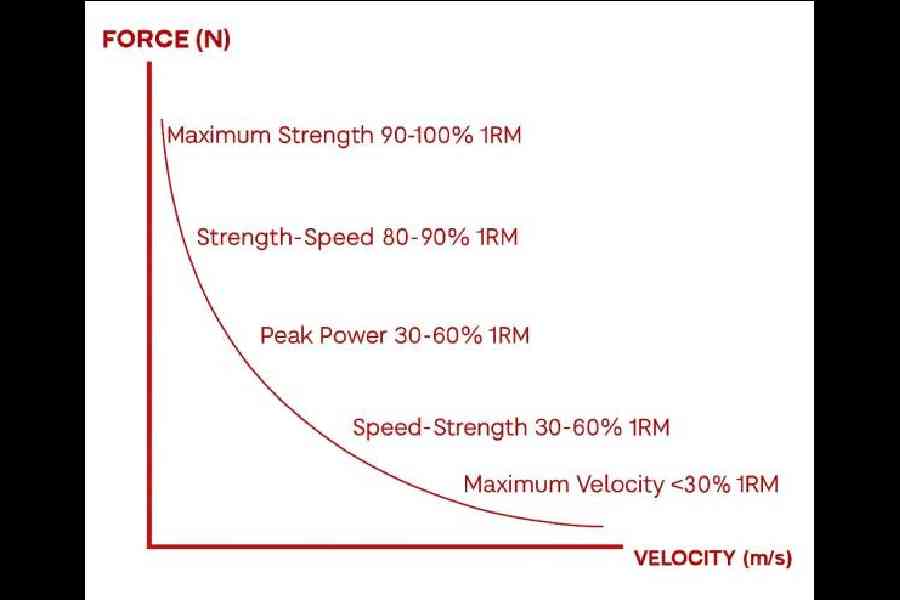
Force-velocity curve
The “aerobicisation” of recreational and competitive sports conditioning is a poor carry-over from the previous decade and most recreational athletes in our country suffer from poor muscle mass, which is a precursor to diabetes and other related chronic health complications. In the area of sports, although we value and practise the training of endurance, power, speed, agility, balance, coordination, accuracy, flexibility, and stamina, we consider strength to be the mother of them all.
Strength is defined as the ability or capacity to resist, overcome, or compensate against any kind of stress or resistance. It is the ability of a muscle or a muscle group to generate muscular force under a given specific velocity.
ORIGINS OF STRENGTH SCIENCE
The earliest reference to formal strength training occurs in Chinese texts dating as far back as 3,600 BC when emperors made their subjects exercise daily (Webster, 1976). During the Zhou dynasty, potential soldiers had to pass weightlifting tests before being allowed to join the armed forces.
There is abundant evidence that weight training was used in ancient Egypt and India, while the Greeks left numerous sculptures and illustrations of their athletes training with stone weights.
The sixth century was known as the Age of Strength, where competitions involved lifting huge stones. In his famous treatise, Preservation of Health, the ancient physician Galen refers frequently to exercising with weights (halteres). He even classified exercises into “quick” (exercises without weight) and “violent” (performed with weights). The Roman poet Martial had this insightful opinion: “Why do strong men labour with stupid dumbbells? A far better task for men is digging.”
Modern research studies into the use of weights/resistance training indicate that these ancient Roman men were not so “stupid” after all!


